 Back to Updates
ZAHA HADID ARCHITECTS REVEALS ORBIT-STATION INTERIOR CONCEPTS
Fluid, parametric interior designs for the upcoming commercial suites at Orbit-Station promise the most beautiful living spaces ever created in space.
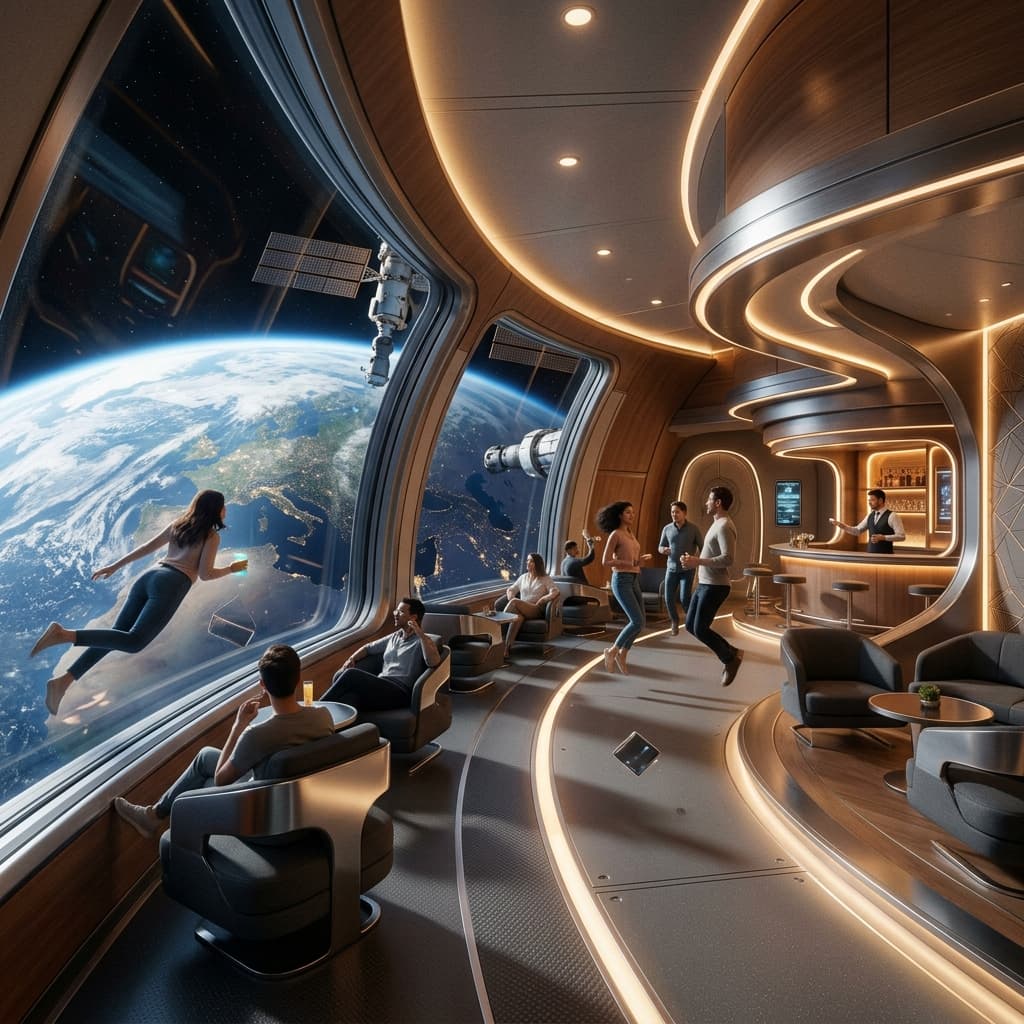
Zaha Hadid Architects (ZHA) has unveiled the interior design concepts for Orbit-SpaceX's commercial suites aboard Orbit-Station, presenting a vision of space habitation that is as aesthetically stunning as it is functionally innovative. The designs, created by ZHA's computational design group in collaboration with Orbit-SpaceX's habitat engineering team, feature flowing, organic forms that leverage the unique possibilities of microgravity architecture.
The presentation, held at ZHA's London headquarters and simultaneously broadcast to Orbit-Station via Starlink, revealed six distinct suite configurations ranging from intimate two-person "Cocoon" modules to the expansive "Nebula" penthouse — a multi-room suite measuring over 100 cubic meters of usable volume.
"In space, there is no floor, no ceiling, no up, no down," said Patrik Schumacher, ZHA's principal architect and creative director. "This liberation from gravity is also a liberation from the constraints that have defined architecture for 10,000 years. Our designs embrace this freedom completely — every surface is a living surface, every angle is habitable."
The Cocoon module, designed for couples or solo travelers on short-duration stays, features a continuous curved interior surface finished in a warm, tactile material that ZHA calls "AstroSilk" — a proprietary fabric developed by Italian textile manufacturer Loro Piana specifically for spacecraft interiors. The material is antimicrobial, flame-retardant, and extraordinarily soft, providing both comfort and safety in the enclosed environment.
The Nebula penthouse, the crown jewel of the collection, is a three-room suite featuring a sleeping chamber, a social lounge, and a private observation pod with 270-degree views of Earth. The observation pod uses a revolutionary curved glass panel manufactured by Corning that provides structural integrity while maximizing the visual field — guests will feel as though they are floating in open space, with only an invisible barrier between them and the cosmos.
Lighting in all suite configurations is fully dynamic, using OLED panels embedded throughout the curved interior surfaces. These panels can simulate natural daylight cycles (critical for maintaining circadian rhythms in a 90-minute orbital day/night cycle), project calming natural imagery, or respond to music and mood with synchronized color displays. ZHA's computational design team developed algorithms that create unique lighting compositions for each guest based on their personal preferences and biometric data.
Furniture in the suites takes on entirely new forms. Without gravity, traditional seating and bedding are unnecessary. Instead, ZHA has designed "nest" structures — padded enclosures that guests can enter and float within, their bodies gently cushioned on all sides. The nests can be configured for sleeping, working, dining, or socializing, adapting their shape through a system of pneumatic actuators controlled by the guest's movements.
Materials selection throughout the suites reflects ZHA's commitment to sensory richness. In addition to AstroSilk fabrics, the designs feature hand-finished Japanese Urushi lacquer accents, Italian marble elements (chosen for their visual beauty and mass — which provides a subtle gravitational comfort in microgravity), and 3D-printed titanium fixtures that showcase the precision of aerospace manufacturing.
The suites' climate systems far exceed the utilitarian standards of traditional spacecraft. Each module maintains independent temperature and humidity control, supplemented by a "scent system" that diffuses natural aromatherapy compounds — a feature added after research indicated that familiar scents significantly reduce the anxiety that some travelers experience in the space environment.
Construction of the first suite modules is scheduled to begin in 2026, with installation aboard Orbit-Station planned for mid-2027. Reservations for the inaugural season are already available, with prices starting at $250,000 per night for the Cocoon module and $1.2 million per night for the Nebula penthouse.