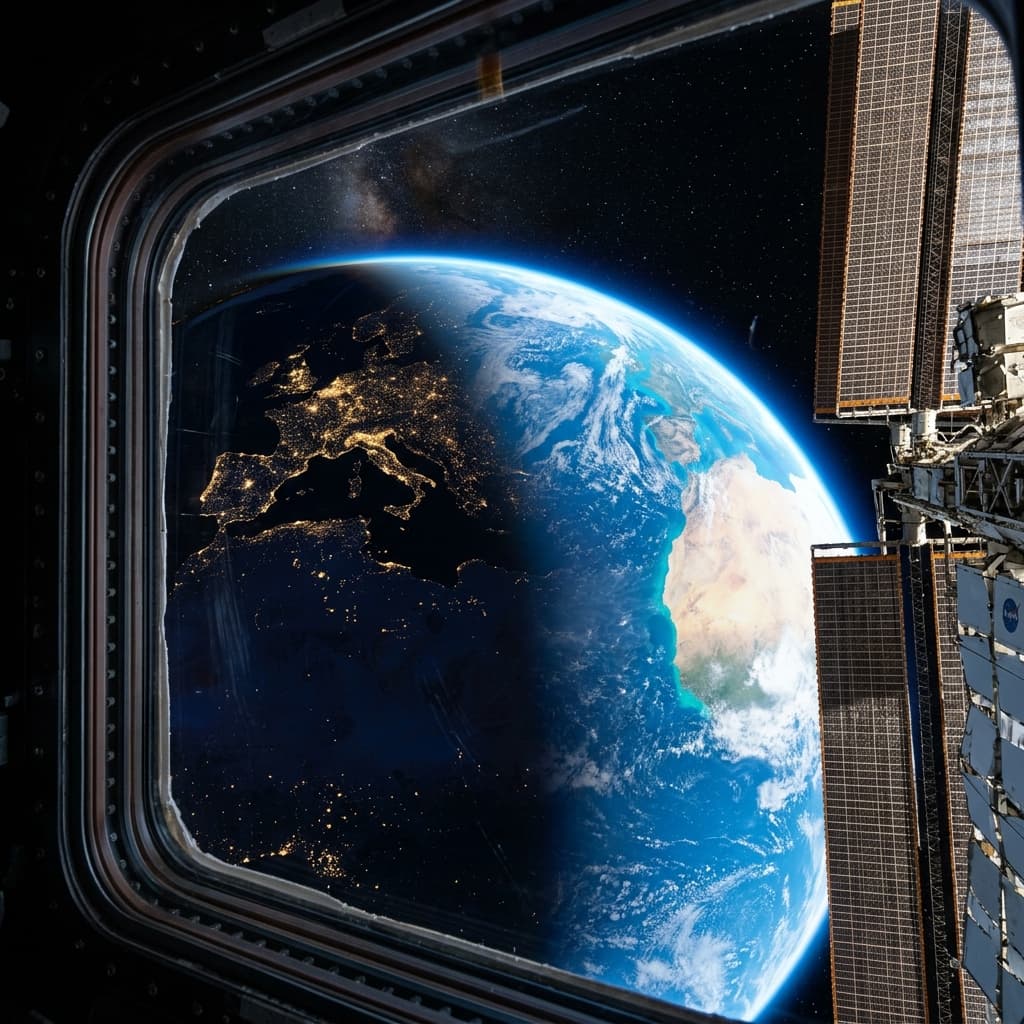
The Habitation and Logistics Outpost reaches its Near-Rectilinear Halo Orbit, establishing the cornerstone of the Lunar Gateway station.
A SpaceX Falcon Heavy rocket has successfully delivered NASA's Habitation and Logistics Outpost (HALO) module into a Near-Rectilinear Halo Orbit (NRHO) around the Moon, marking the arrival of the first permanent human-rated habitat in cislunar space. The mission, which launched from Kennedy Space Center's Launch Complex 39A on June 10, 2025, achieved orbital insertion on June 15 following a five-day transit and a series of precision maneuvers.
HALO, developed by Northrop Grumman in partnership with NASA and with propulsion support from Orbit-SpaceX, will serve as the living quarters and command module for the Lunar Gateway — an international space station that will orbit the Moon and serve as a staging point for lunar surface missions, deep-space research, and eventually, missions to Mars.
"This is the moment that sustained human presence beyond Earth orbit becomes real," said NASA Administrator Bill Nelson. "With HALO in position, we have a home near the Moon. Astronauts will live and work there, scientists will conduct research there, and one day, crews bound for Mars will depart from there."
The Falcon Heavy launch itself was a marvel of precision. The rocket's three first-stage cores performed nominally, with both side boosters returning to landing pads at Cape Canaveral and the center core landing on the drone ship "A Shortfall of Gravitas" in the Atlantic Ocean. The upper stage then executed a complex series of burns to place HALO on its translunar trajectory.
The NRHO orbit selected for Gateway offers unique advantages over traditional lunar orbits. The highly elliptical path brings the station as close as 3,000 kilometers from the lunar surface at its nearest point, while its farthest point extends to nearly 70,000 kilometers. This orbit provides near-continuous line-of-sight communication with Earth, excellent lighting conditions for solar power generation, and relatively low station-keeping propellant requirements.
HALO itself is a pressurized module approximately 10 meters in length, providing living space for up to four crew members. It includes life support systems, sleeping quarters, a command and communication center, and docking ports for visiting spacecraft including Orion capsules and Starship lunar landers. A robotic arm mounted on the module's exterior will assist with maintenance operations and the attachment of future Gateway modules.
Orbit-SpaceX's contribution to the HALO mission extends beyond the Falcon Heavy launch. The company provided the module's primary propulsion system — a modified version of the Draco thruster cluster used on SpaceX's Dragon spacecraft. These thrusters performed the critical lunar orbit insertion burn and will provide station-keeping capability throughout HALO's operational life.
The international dimension of the Gateway program is significant. Canada has contributed the Canadarm3 robotic system, the European Space Agency is developing the ESPRIT refueling module, and Japan's JAXA is providing life support technology. The partnership structure ensures that Gateway will serve as a hub for international cooperation in deep space, much as the International Space Station has done in low Earth orbit for over two decades.
For Orbit-SpaceX, the successful HALO insertion validates the company's position as a key infrastructure provider for lunar operations. The company is already under contract to deliver additional Gateway modules using Starship, and is actively bidding on contracts to supply the station with crew rotation services, cargo deliveries, and propellant.
The next Gateway milestone will be the launch of the Power and Propulsion Element (PPE), which will provide the station with high-power solar electric propulsion and enhanced communication capabilities. That launch, also planned aboard a Falcon Heavy, is scheduled for early 2026.