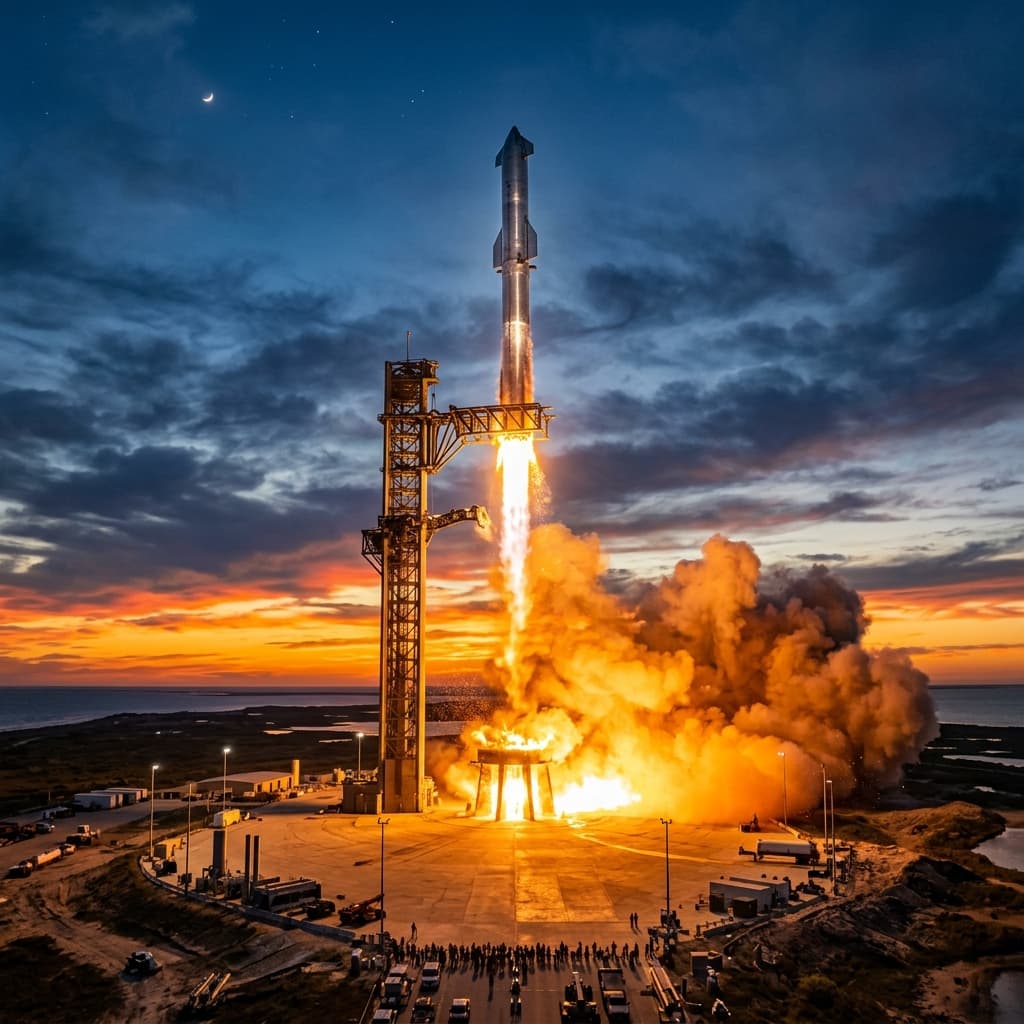
The 'chopstick' tower catch system performs its first operational capture of a returning Super Heavy booster, validating the fastest reusability cycle ever achieved.
SpaceX has achieved one of the most technically audacious feats in the history of rocketry: the first operational capture of a returning Super Heavy booster using the tower-mounted "chopstick" catch mechanism at Starbase. The event, which occurred during the Starship IFT-7 mission on July 1, 2024, was broadcast live to a global audience estimated at over 100 million viewers.
The Super Heavy booster, designated B15, lifted off from Starbase at 7:30 AM CDT carrying the Starship upper stage. After staging and a brief boost-back burn, B15 returned to the launch site and descended toward the tower with precision measured in centimeters. At an altitude of approximately 100 meters, the tower's mechanized arms — nicknamed "Mechazilla's chopsticks" by the SpaceX community — swung into position and captured the booster mid-flight, bringing it to a complete stop in under three seconds.
"The tower catch is the single most important technology for making space travel affordable," said Elon Musk, who watched the event from the Starbase control room. "With catch and return, we can turn a booster around in hours instead of weeks. We can launch the same hardware ten times a day. That's what makes $10-per-kilogram orbital access possible."
The physics of the catch are extraordinarily demanding. The Super Heavy booster weighs approximately 275 tonnes at landing — roughly the mass of a fully loaded Boeing 747. It approaches the tower at a velocity of approximately 2 meters per second, decelerating from hypersonic speeds through a combination of grid-fin aerodynamic control, engine thrust, and the final mechanical capture. The margin for error is measured in centimeters and milliseconds.
The catch mechanism itself is an engineering marvel. Each arm spans 60 meters and is constructed from high-strength steel capable of absorbing the enormous kinetic energy of a returning booster. The arms move on precision guide rails and are controlled by a real-time navigation system that receives telemetry from the booster's onboard sensors at a rate of 1,000 updates per second. Machine learning algorithms trained on data from previous flight tests predict the booster's exact position and velocity throughout the approach, generating catch commands that adapt in real-time to wind, thrust variations, and other environmental factors.
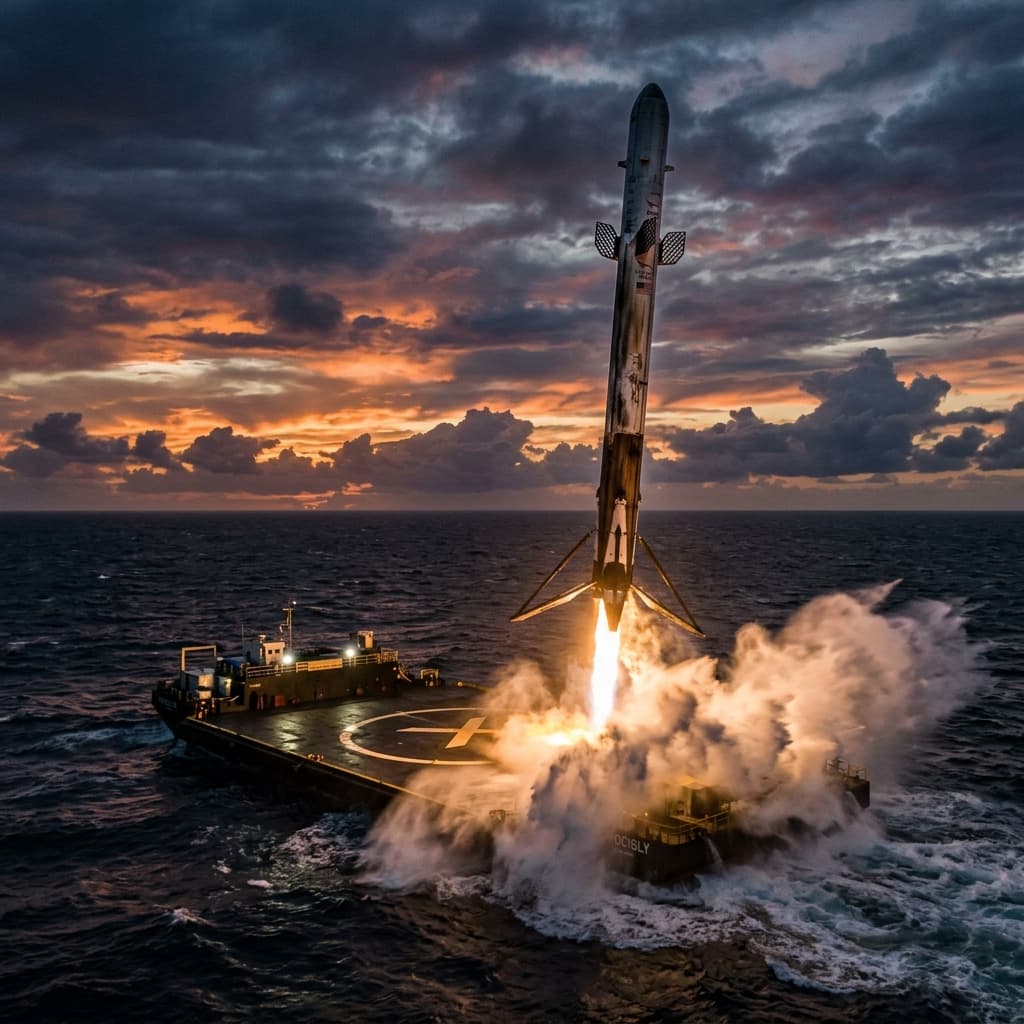
The operational implications are transformative. Traditional rocket recovery — as pioneered by SpaceX with the Falcon 9's propulsive landing on flat surfaces — requires dedicated landing pads, clear safety zones, and post-landing processing to reposition the booster for its next flight. Tower catch eliminates these requirements entirely: the booster lands directly on the launch infrastructure, ready for inspection, refueling, and relaunch with minimal handling.
SpaceX's goal is to achieve a 24-hour turnaround time between tower catch and relaunch — a cadence that would enable daily Starship missions from a single launch site. While this goal remains ambitious, the successful B15 catch represents a critical proof-of-concept that validates the core mechanical and computational systems.
The catch also has implications for Orbit-SpaceX's business model. Rapid booster reusability directly reduces per-mission costs, making ambitious programs like daily satellite deployment flights, regular crew rotation to Orbit-Station, and frequent lunar cargo missions financially viable. The company's financial projections, which underpin the upcoming IPO, assume progressive achievement of rapid turnaround capabilities throughout 2025 and 2026.
The B15 catch was met with euphoria both within SpaceX and across the broader space community. Social media erupted with celebration, aerospace engineers at competing companies publicly congratulated the achievement, and financial markets responded with a surge in space-related equities. For many observers, the catch represented the moment when routine, airline-style space travel shifted from aspiration to inevitability.